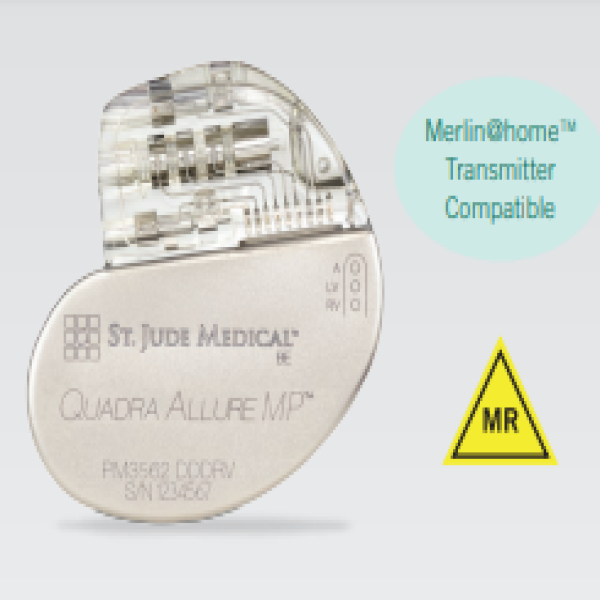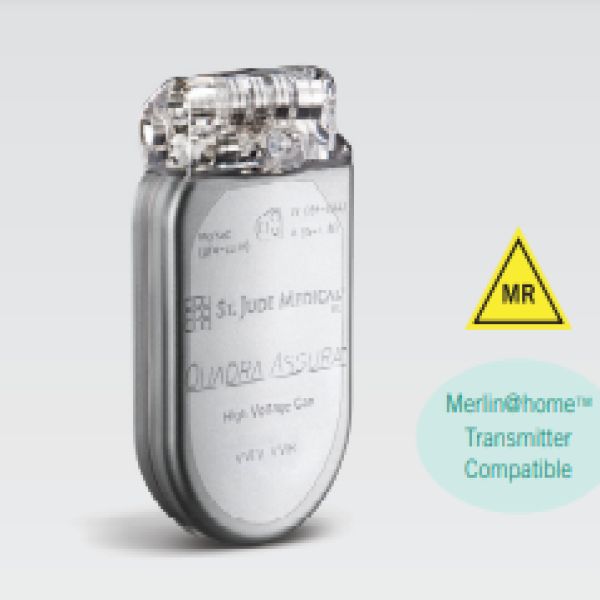
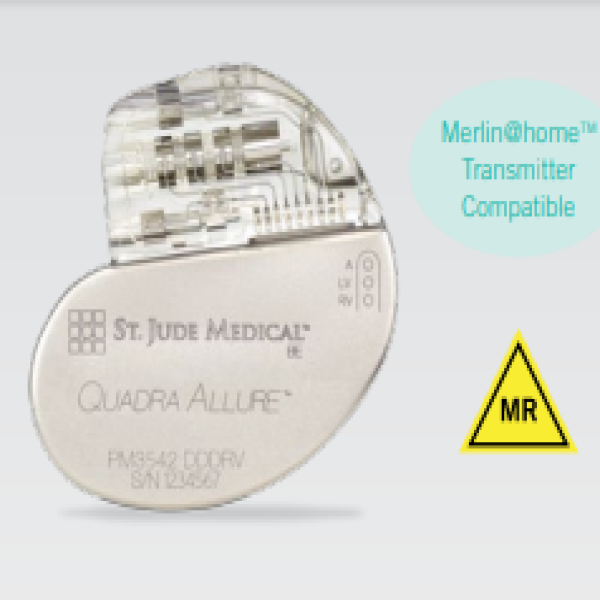
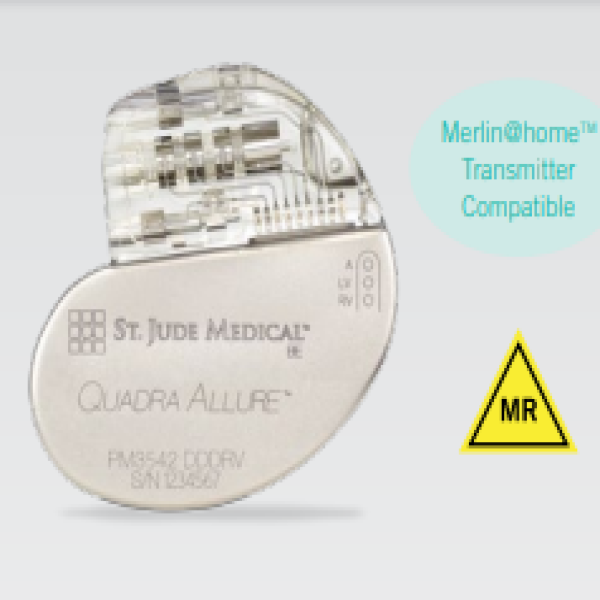
Quadra Allure™ CRT devices
- Allows patients to undergo MRI scans when used with MRI Ready leads from St. Jude Medical*
- SyncAV™ CRT technology dynamically adjusts AV delays based on patient’s intrinsic conduction to encourage patient-tailored biventricular pacing
Elevate Response Easily with Auto VectSelect Quartet™ Test offering an efficient workflow for complete results and programming at the touch of a button - The Quadra Allure™ CRT-P and Quartet™ quadripolar LV pacing lead feature four pacing electrodes and 14 pacing vectors to provide more options and greater control to address complications at and post implant to improve CRT response
Call Us Now
- Allows patients to undergo MRI scans when used with MRI Ready leads from St. Jude Medical*
- The Quadra Allure™ CRT-P and Quartet™ quadripolar LV pacing lead feature four pacing electrodes and 14 pacing vectors to provide more options and greater control to address complications at and post implant to improve CRT response
- SyncAV™ CRT technology dynamically adjusts AV delays based on patient’s intrinsic conduction to encourage patient-tailored biventricular pacing
- Elevate Response Easily with Auto VectSelect Quartet™ Test offering an efficient workflow for complete results and programming at the touch of a button
- Angled header and physiologic tear drop shape provide better lead wrap
- CorVue™ Congestion Monitoring feature monitors the intrathoracic impedance and provides the option for both patient and physician alerts
- The DirectTrend™ Report provides a summary of three month daily, one year weekly or one year daily diagnostic trends
- Better patient utilization from day one when paired with the Merlin@home™ transmitter at point of care1
- AT/AF alerts can be programmed to notify their clinics when a programmed AT/AF threshold or continuous episode duration has been exceeded, or when a high ventricular rate accompanies the AT/AF episode
- Exclusive AF Suppression™ algorithm is clinically proven to suppress episodes of paroxysmal and persistent AF
- AT/AF burden trend provides a graphical representation of the percentage of time in AT/AF and the number of AT/AF episodes in the previous 52 weeks
- Up to 14 minutes of stored electrograms help identify key intrinsic and pacemaker-related events and simplify the diagnosis of complex ECG rhythms associated with heart failure
- Longevity offers 8,2 years of service life supported by a six year warranty*
Indications: Implantation of a CRT-P is indicated in one or more of the following permanent conditions:
syncope, presyncope, fatigue, disorientation due to arrhythmia/bradycardia, or any combinations of those
symptoms. Implantation of a CRT-P is indicated for patients who would benefit from resynchronization of the
right and left ventricles of have one or more conventional indications for the implantation of a pacemaker.
Rate-Modulated Pacing is indicated for patients with chronotropic incompetence, and for those who would
benefit from increased stimulation rates concurrent with physical activity. Dual-Chamber Pacing is indicated
for those patients exhibiting: sick sinus syndrome, chronic, symptomatic second- and third-degree AV block,
recurrent Adams-Stokes syndrome, symptomatic bilateral bundle branch block when tachyarrhythmia and other
causes have been ruled out. Atrial Pacing is indicated for patients with sinus node dysfunction and normal
AV and intraventricular conduction systems. Ventricular Pacing is indicated for patients with significant
bradycardia and normal sinus rhythm with only rare episodes of A-V block or sinus arrest, chronic atrial
fibrillation, severe physical disability. AF Suppression™ algorithm is indicated for suppression of paroxysmal
or persistent atrial fibrillation episodes in patients with one or more of the above pacing indications.
Contraindications: Implanted Cardioverter-Defibrillator (ICD). Devices are contraindicated in patients
with an implanted cardioverter-defibrillator. Rate-Adaptive Pacing may be inappropriate for patients who
experience angina or other symptoms of myocardial dysfunction at higher sensor-driven rates. An appropriate
Maximum Sensor Rate should be selected based on assessment of the highest stimulation rate tolerated by
the patient. AF Suppression™ stimulation is not recommended in patients who cannot tolerate high atrial- rate stimulation. Dual-Chamber Pacing, though not contraindicated for patients with chronic atrial flutter,
chronic atrial fibrillation, or silent atria, may provide no benefit beyond that of single-chamber pacing in such
patients. Single-Chamber Ventricular Demand Pacing is relatively contraindicated in patients who have
demonstrated pacemaker syndrome, have retrograde VA conduction, or suffer a drop in arterial blood pressure
with the onset of ventricular pacing. Single-Chamber Atrial Pacing is relatively contraindicated in patients
who have demonstrated compromise of AV conduction. Atrial Fibrillation. Allure™ devices are contraindicated
in patients having chronic atrial fibrillation or intermittent atrial fibrillation that does not terminate. For specific
contraindications associated with individual modes, refer to the programmer’s on-screen help.
Potential Adverse Events: The following are potential complications associated with the use of any pacing
system: air embolism, body rejection phenomena, cardiac tamponade or perforation, hematoma, bleeding
hematoma, seroma, formation of fibrotic tissue, local tissue reaction, inability to interrogate or program due to
programmer or device malfunction, infection/erosion, interruption of desired pulse generator function due to
electrical interference, either electromyogenic or electromagnetic, lead malfunction due to conductor fracture
or insulation degradation, loss of capture or sensing due to lead dislodgement or reaction at the electrode/
tissue interface, loss of desired pacing and/or sensing due to lead displacement, body reaction at electrode
interface, or lead malfunction (fracture or damage to insulation), loss of normal device function due to battery
failure or component malfunction, pacemaker migration or pocket erosion, pectoral muscle or diaphragmatic
stimulation, phrenic nerve stimulation, pneumothorax/hemothorax, endocarditis, excessive bleeding, induced
atrial or ventricular arrhythmias, myocardial irritability, pericardial effusion, pericardial rub, pulmonary
edema, rise in threshold and exit block, valve damage, cardiac/coronary sinus dissection, cardiac/coronary
sinus perforation, coronary sinus or cardiac vein thrombosis.
Refer to the User’s